一、气象与自然环境类
8 downburst
4 题 · 按「意思相近」分组(同义问题归一组) · 播放完后显示参考答案
1图片题
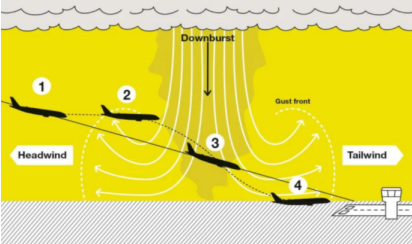
示例: This is a diagram illustrating the impact of a downburst on an aircraft during flight.
On the top of the diagram, there are clouds with a "Downburst" labeled, indicating a strong downward air current.
In the middle of the diagram, four aircraft (numbered 1 to 4) are shown flying through different stages affected by the downburst. The aircraft's flight path curves due to the changing wind conditions.
At the bottom of the diagram, the ground with an airport control tower is depicted.
On the left side of the diagram, a "Headwind" (wind blowing against the aircraft) is marked.
On the right side, a "Tailwind" (wind blowing in the same direction as the aircraft) and a "Gust Front" (the leading edge of the downburst's wind) are labeled.
Downbursts can cause sudden and drastic changes in wind speed and direction, posing serious hazards to aircraft, especially during takeoff and landing. Pilots need to be trained to recognize and handle such weather phenomena to ensure flight safety.
中文:
这是一幅展示下降气流对飞行中飞机影响的示意图。
在示意图的上部,有标注着 “Downburst(下降气流)” 的云层,代表强烈的向下气流。
在示意图的中部,四架飞机(编号 1 到 4)展示了在受下击暴流影响的不同阶段飞行的状态。由于风况变化,飞机的飞行路径发生弯曲。
在示意图的下部,描绘了带有机场控制塔的地面。
在示意图的左侧,标注有 “Headwind(逆风)”,即吹向飞机的风。
在右侧,标注有 “Tailwind(顺风)”(与飞机同方向吹的风)和 “Gust Front(阵风锋)”(下降气流风的前缘)。
下降气流会导致风速和风向突然且剧烈变化,对飞机,尤其是起飞和降落阶段的飞机构成严重危险。飞行员需要接受训练,以识别和应对此类天气现象,确保飞行安全。
2图片题
3图片题
4图片题